Mobirise

Turning Legacy Firmware-Based Scales into High-End Labeling Systems (Without Touching Core Code)

For weighing scale manufacturers (OEMs), a proven, OS-less firmware is an invaluable asset: it is rock-solid, time-tested, loved by customers, and deployed across thousands of units. However, today’s market demands complete printing flexibility: Price-Computing (Weight-Price) labels, allergen tracking, traceability data, 2D barcodes, and fully customizable layouts for every customer.

Rewriting legacy scale firmware to embed a complex graphical print engine is expensive, risky, and time-consuming. BuilderOne and LabelOne (L1/B1) solve this challenge with a seamless "Ghost Engine" architecture.
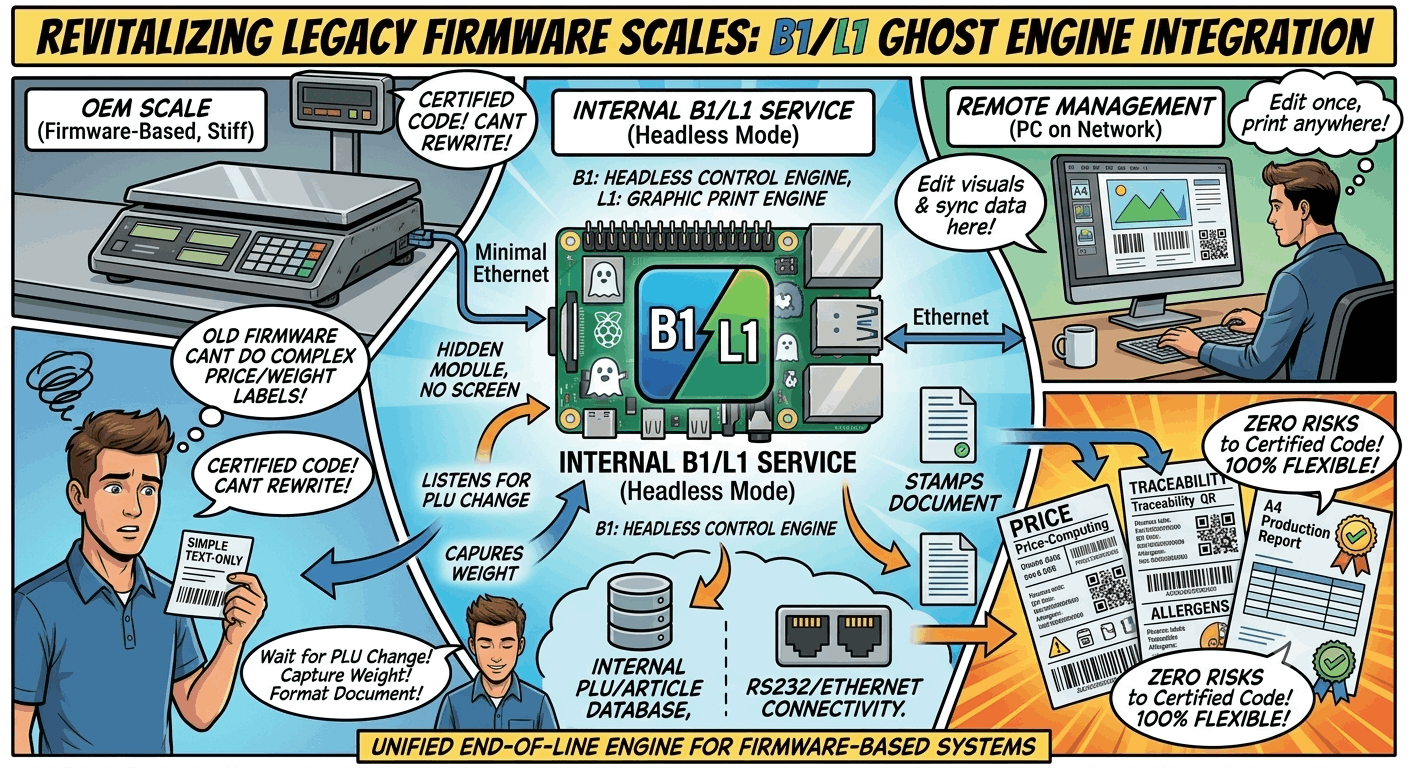
The Solution: A Hidden Smart Module Inside the Scale

Instead of overhauling the scale’s software, the architecture splits the workload into invisible, highly efficient components:

  1. Minimal Scale Firmware Tweaks: - The scale continues doing what it does best—calculating precise weight. Its firmware only needs a tiny update to send basic data over Ethernet (PLU changes, stable weight events, batch totals).
  2. The Embedded Raspberry Pi "Brick" - A compact, low-cost board like a Raspberry Pi 4 or Pi 5 is mounted directly inside the scale enclosure—no external display or monitor required.
  3. The L1/B1 "Ghost" Application - Running quietly in the background on the Raspberry Pi, the BuilderOne application operates in headless ("Ghost") mode:
  • Holds an internal database containing all article/PLU records.
  • Listens continuously for Ethernet signals coming from the scale.
  • Upon receiving a PLU selection or weight confirmation, it instantly merges the data into the LabelOne template and fires the print job to the label printer.

Centralized Remote Management via PC

How do you update products, prices, and label layouts if the embedded Raspberry Pi is hidden with no screen?

All management tasks are handled remotely over the local network:

  • Visual Label Design - Using LabelOne on any office PC connected to the network, technicians can create or adjust label layouts (from standard barcode stickers to full A4 production reports).
  • Database Management - A simple PC application updates the PLU database—prices, ingredients, allergens, and barcodes—and automatically syncs it with the embedded Raspberry Pi.

Why OEM Scale Manufacturers Choose This Approach

  • Zero Metrological Risk - Core weighing logic and certified firmware remain 100% untouched.
  • Low Hardware Overhead - Adding an internal Raspberry Pi keeps the overall Bill of Materials (BOM) extremely low.
  • Maximum Market Agility - Legacy scales instantly gain modern Weight-Price labeling features without forcing operators to learn a new interface.

Scale Engineering FAQ

  • What happens if the local network goes down? The "Ghost" app on the Raspberry Pi relies on its local embedded database, allowing the scale to print labels continuously even when offline.
  • How does the scale talk to the Raspberry Pi? Via standard Ethernet sockets using lightweight text strings—extremely easy to add to any legacy C/C++ firmware.
  • Can it handle both single-item labels and batch totals? Yes. L1/B1 natively processes item-level weights as well as multi-level totalizing (box, pallet, end-of-shift reports) triggered by the scale.

HTML Website Builder